As this is my first post of the year, on behalf of all of us at GBM Asset Management, let me wish everyone a somewhat belated Happy New Year for 2026.
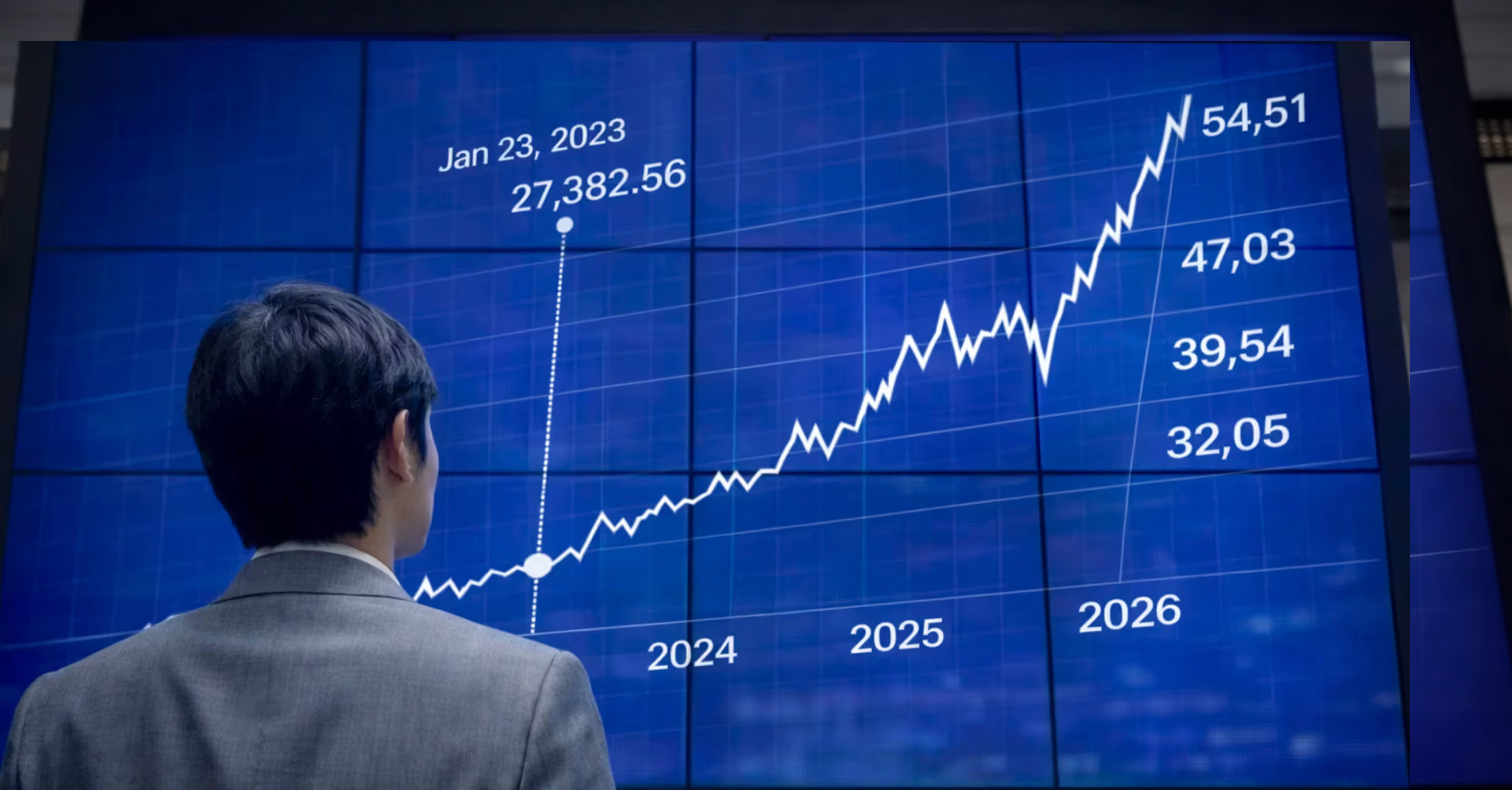
The year has started pretty well for Japan’s equity markets, with the NKY225 touching fresh highs last week, continuing a remarkable run in which the index has doubled in just three years. The obvious question for the new year ahead is whether this remarkable rally can continue.
Many have cited the sudden prospect of a snap general election next month as fueling the new year optimism, with its promise of a more workable mandate for PM Takaichi’s reflationist policies. And certainly reflationary policies are market friendly – as I discussed last year shortly after her ascension back in October (Takaichi’s Reflation Push Could Do More to Transform Japan Than Any Reformist Manifesto). But while a Takaichi victory would be a tailwind, for me, a more sustained continuation of the current rally would require further market and regulatory reforms of the kind that have helped drive it this long.
To understand this view, it is worth recalling what lit the fuse of the current rally in the first place.
The early 2023 inflection: when the TSE finally forced everyone to take notice of valuation, and of them.
Obviously, the current impressive Japan rally has many drivers: the end of deflation, yen weakness, geopolitics, technology, etc. But if one policy moment deserves pride of place, it is the Tokyo Stock Exchange’s directive to listed companies – in early 2023 – to take “Action to Implement Management that Is Conscious of Cost of Capital and Stock Price.”
This directive was not a formal amendment to the Corporate Governance Code, nor was it binding. It was – like most previous such TSE directives over the years – merely a market practice request for voluntary action, its phrasing modest and muted. It asked listed companies to take specific actions to be more conscious of cost of capital and stock price in alignment with what was already expected under Corporate Governance Code Principle 5.2, and, “to comply or explain” if that alignment fell short.
The TSE and FSA had put out many such reform initiatives before (on cross-shareholdings, governance, board independence, shareholder rights, market segmentation, trading hours, etc) since publishing Japan’s first Stewardship Code in 2014 and then its first Corporate Governance Code the following year (see the “Track Record” section at bottom). All of these changes have had the same intention, but few ever moved prices. For some reason, however, this time was different.
For many companies, and the market overall, the March 2023 call for action served as a wake up call. Maybe it was the loaded inference it put on companies’ reputations by making its focus on stock price, or maybe it just dovetailed with the impact of emerging inflation. But in its wake, both management and investors have now come to pay attention to what Japan’s government wants — whether it be through the TSE, the FSA, or METI. And what the government clearly wants – and wanted all along – is higher stock prices.
And they still want that. The government has been consistent and open about its ambitions: more domestic household stock ownership, deeper capital markets, and an “asset-management-friendly” Japan – and higher returns. New expanded NISA has coopted households’ buy-in. Market access and plumbing has been modernised and improved. Disclosure and practice has been internationalised. And, crucially, boards are being encouraged or cajoled to think about capital efficiency and profits. The government’s ‘grand plan’ is ongoing. Good progress has definitely been made; their targets are still a way off.
Which brings us to the what’s next in the plan: the next iteration.
The next inflection higher? Revising the Corporate Governance Code again
In June 2025, the FSA published its Action Programme for Corporate Governance Reform 2025, explicitly flagging another review of the Corporate Governance Code as a next policy priority. In October 2025, an expert advisory panel convened for the first time to begin that process - the first full revision cycle since 2021. This timing suggests the revised Code will likely come out around June this year, with companies expected to align to it by the year-end.
On its face, governance code revisions sound procedural. In context, they are not. The agenda items being discussed - disclosure timing (including pushing Annual Securities Reports ahead of AGMs), board effectiveness and oversight, simplification of “box-ticking” provisions, and clearer expectations around capital allocation - go directly to how pressure is transmitted from markets to management.
This is not about adding pages to a rulebook. It is about tightening the loop between valuation, accountability, and action.
Activism has scaled and normalized; that changes the game
The timing is not accidental. Shareholder activism in Japan has moved from novelty to infrastructure. Two articles last week frame this backdrop perfectly. The Nikkei Asia (Jan 13) reports how Japan posted a record number of activist campaigns in 2025, overtaking Europe and sitting behind only the US. While the Financial Times (Jan 14) goes further, noting that activists now control a measurable share of Japan’s equity market and are being pushed, by sheer scale, toward larger and more complex interventions.
This matters because the next phase of activism is not about urging incremental buybacks. It is about operational turnarounds, contested take-privates, M&A and whole-company outcomes. In other words, about the emergence of a genuine market for corporate control - precisely what earlier generations of activists complained Japan lacked. A governance code revision in 2026 that sharpens board accountability for capital allocation, improves information symmetry ahead of shareholder meetings, and reduces procedural excuses would land squarely in the path of this force.
So what would actually move the market higher?
The base case outcome of the revision process is incrementally better governance. The market-moving outcome is something else: reinforcing the post-2023 valuation push with governance mechanics that make inaction not just unfashionable, but existential. The changes most likely to excite investors are not dramatic slogans, but practical ones: faster and better disclosure, clearer expectations around idle balance sheets, and boards that must explain not just strategy, but capital structure and resource allocation in concrete terms. If that happens, the signal to global capital will be clear: the Japan rally is not done.
The setup is there
So in sum, Japan enters this New Year with an unusually aligned setup – despite the elevated level of stock prices. Activist capital is deeper and more confident. Private equity is entrenched. Both sit on substantial ‘dry powder’. Domestic households are being nudged – or indeed shoved - into markets. Boards are being forced to focus on valuation. And, crucially, the authorities have demonstrated that now when they push, markets will likely respond. So, in early 2023, the TSE showed that through reform dictates, it could ignite a rerating by forcing companies to confront price. Now, 3 years later, the question is whether they can use the same means to add accelerant.
We can only hope — but hope, this time, rests on an improving track record (as outlined below).




.svg)