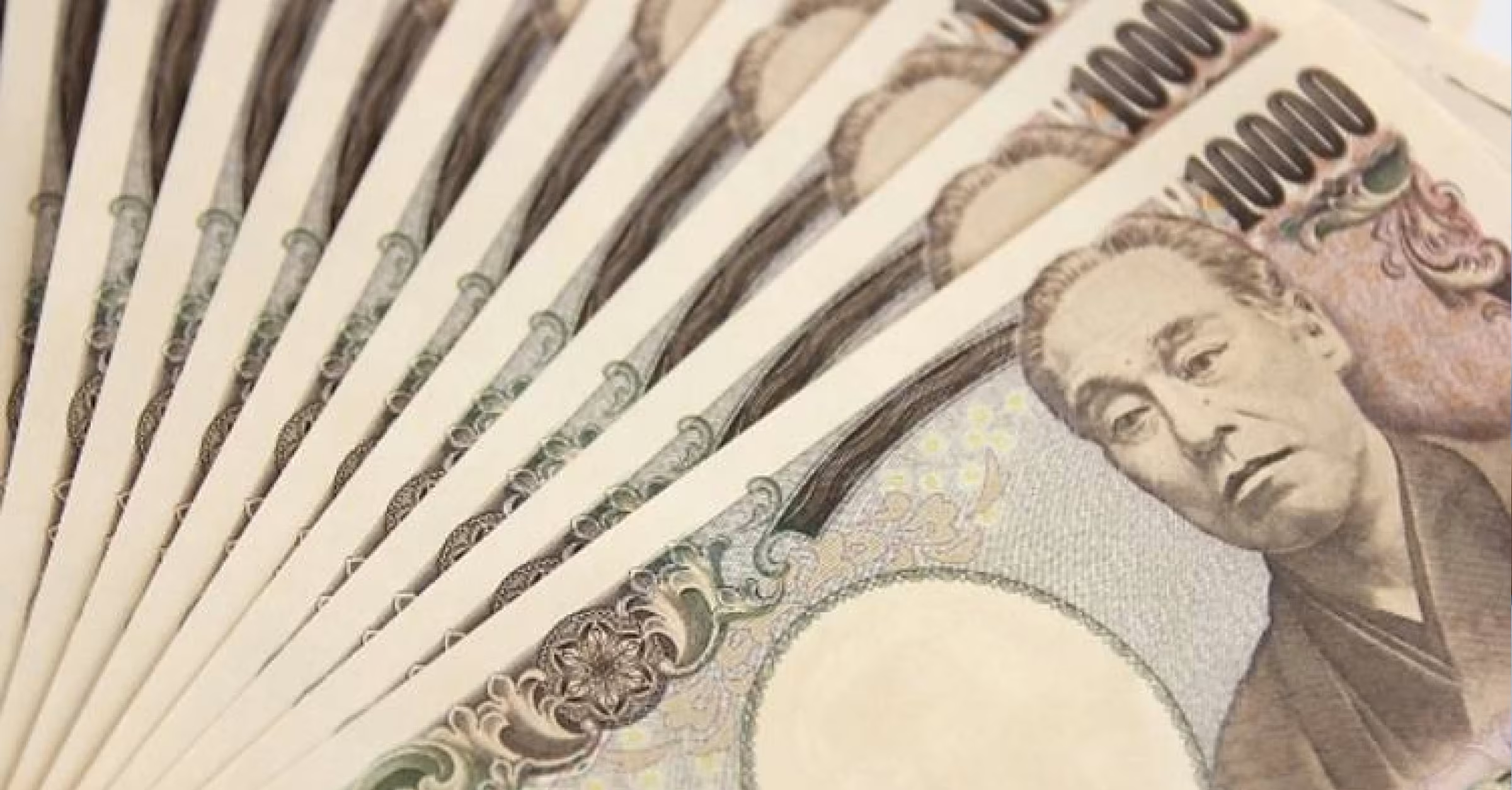
It’s been a common refrain in recent years to hear predictions of how low the yen could fall and by when - the yen is going to 180! Or 200! And so on.
I too am generally in the further-yen-weakness camp. But the parallels drawn by some amid the current parliamentary debate on PM Takaichi’s supplementary budget to the fated UK budget under British PM Liz Truss in September 2022 remind me that one key aspect of Japan’s weakening-yen trend may be misunderstood. And that is, that inherent within the nature of the yen’s weakness in recent years is a potential for a snapback: a large, perhaps sudden reversal back toward yen strength. Even if we remain broadly comfortable that the weakening trend persists, it is worth understanding why this risk is ever-present - especially ahead of the BOJ’s December policy meeting, where a rate hike is under discussion.
To be sure, it is understandable how Takaichi’s supplementary budget - the largest since COVID, amid already worrying signs of inflation - drew parallels with the Truss episode, especially after its proposal prompted accelerated sell-offs in both JPY and JGBs. But that reflex overlooks an important distinction about recent yen weakness, which is that the overwhelming source of yen selling is domestic outflow, not the withdrawal of foreign inflows. Put bluntly (and at some risk of oversimplifying it), it is Japanese selling more yen to buy more foreign assets - not foreigners fleeing Japan.
According to the latest data, roughly half of new NISA contributions - which themselves have grown more than 50% since their relaunch in January 2024 - are being channelled into overseas equities, mainly via global and US equity mutual funds. (The irony, of course, is that this outward shift is happening precisely when the Japanese government is investing diplomatic and regulatory energy into attracting foreign investment into Japanese markets.)
Why this matters is because outflows driven by residents come with a built-in potential energy for a snapback. Japanese private-sector portfolios - chasing higher risk and better returns - have been rotating abroad at scale in recent years, often with leverage. These flows may well continue and could even accelerate amid concerns about Japan’s relative growth or inflation prospects. But the foreign assets purchased in this rotation remain owned by Japanese residents. Unless those owners intend to leave Japan permanently, there is always an inherent possibility of repatriation, at some future time.
In this sense, the flows that underpin recent yen weakness differ meaningfully from the flight from GBP that followed the Liz Truss budget. The yen is being sold, but the sellers themselves are not leaving; only their money is. This is not capital flight, but rather portfolio rebalancing abroad - without repatriation… at least not yet.
This is not to dismiss the Truss analogy entirely. As I have noted in earlier posts - especially #7 (“Does Japan Have an Inflation Problem?”, 10 November) - the pro-cyclical reflationist policies of Takaichi, arriving amid already rising inflation expectations and a behind-the-curve BOJ, could catalyse an acceleration in private-sector portfolio shifts out of yen-based assets that looks superficially similar to a Truss-like “flight.” But beneath the surface, the structural mechanics differ enough to limit the analogy.
One of the biggest differences, of course, is that Japan continues to run a large current-account surplus, driven overwhelmingly by primary-income earnings on its vast stock of overseas assets - a very different situation versus the UK. So to reiterate, the yen has weakened not because foreign investors are fleeing a deteriorating balance-of-payments position, but because domestic investors have been redeploying capital abroad in search of higher returns. The flows may look similar, but the underlying engines - and the associated risks - are fundamentally different.
So what could trigger a snapback?
The magnitude of these resident outflows - and the latent potential for repatriation - should not be underestimated. Japan’s net international investment position remains one of the largest in the world, with overseas assets held by Japanese residents exceeding ¥500 trillion. This colossal stock of foreign assets means that even small shifts in repatriation behaviour can translate into outsized yen demand. Were households or institutions to start reducing foreign exposures or hedges, the scale of currency turnover could be large enough to produce a meaningful snapback in JPY. The key point is that this latent pool exists precisely because the current flows have been one-directional; once sentiment shifts, the same structural channels that facilitated outflows can work in reverse.
1. Policy convergence - even small moves matter. A BOJ hike - even a modest one - especially if paired with a softening Fed trajectory, compresses the rate differentials that have anchored much of the yen’s trend. Governor Ueda has signalled that a rate hike at the upcoming December meeting is on the table - precisely the sort of convergence catalyst that can trigger a mechanical yen bounce, especially when short-yen positioning is heavy.
2. Flow rotation - the “two-way door” nature of resident outflows. Foreign investors have been net buyers of Japanese equities for weeks, while domestic investors continue to deploy abroad through NISA and other channels. This creates a latent asymmetry: Japanese outflows can suddenly reverse if hedges are adjusted, if FX costs rise, or if offshore assets underperform. Because the marginal seller is domestic, the marginal buyer in a snapback is also domestic - and the size of the overseas asset pool held by Japanese investors is now enormous.
3. Domestic shock - the counter-intuitive yen-strengthening effect of disasters. Japan is one of the few major economies where domestic disasters can trigger yen appreciation, not depreciation. The mechanism is well documented: after past earthquakes (Kobe in 1995, Tōhoku in 2011), markets priced in large-scale repatriation flows by insurers, corporates, and financial institutions to meet reconstruction and payout needs. Even expectations of such flows were enough to spark violent short-covering in FX markets. A similar shock today - whether a major natural disaster, infrastructure failure, or a systemic event that forces sudden domestic liquidity needs - could once again flip the yen sharply stronger, not weaker. In a market already heavily positioned short yen and dominated by resident outflows, this kind of repatriation-driven snapback risk remains structurally embedded in the system.
And any snapback can become self-fulfilling. A yen reversal back to strength may reinforce itself. A rising yen can accelerate repatriation by Japanese, while also attracting additional foreign investment into Japan - something that even PM Takaichi, I think, is hoping for when she appealed to an audience of foreign investors earlier this month (at the FII PRIORITY Asia 2025 conference) to invest in Japan with the extraordinary quip: “Just shut your mouths. And invest everything in me!” (borrowing the line from the popular Attack on Titan manga.)
So in sum, while the weakening trend in JPY looks unstoppable to many, it is not so much a “flight”; it is a trading position by largely Japanese private-sector investors. And such positions can be fickle. Even a modest BOJ step (so beware the next policy decision), one or two softer US prints - or something else - may be all that is required to trigger the reversal that is structurally embedded in Japan’s own outward flows.




.svg)